


Starting a blog is a breeze these days. There are countless content management systems where you can easily and quickly start blogging. However, making your blog a success is a different story. Of course, a blog is useless without visitors, while research shows that more than 90.63% of websites hardly receive organic traffic.
In practice, it turns out that starting a successful blog requires some skills and especially perseverance. So, are you ready to seriously get started with your blog and prepared to invest the time and effort to make it a success? Then this article is perfect for you.
Determine the purpose of the blog
Before you start, it is important to have a clear understanding of the blog’s purpose. Is it a hobby project, affiliate website, or do you have a webshop and want to attract more visitors?
This is an important question to ask yourself beforehand because you can make choices that align with the goal.
Is there a commercial goal?
For a hobby project, it might be less interesting to invest in expensive tools or copywriters because there is no profit goal.
If you already have a profitable webshop and investing in a blog is therefore commercially interesting, there is more room to invest money in the project. Of course, with the expectation of recouping this investment.
We always recommend thoroughly considering the goal before starting your blog. This way, you have a clearer idea of the steps you need to take to achieve this goal.

Create a plan of action to achieve this goal
Once the blog’s goal is clear, we recommend creating a plan of action to achieve this goal. Creating a blog involves quite a few things. Where will you host it, how will you attract visitors, how many texts do you want to write, and what will be the topics of these texts?
These are all things you should determine beforehand to ensure that the blog becomes a success. We have noted a number of points that are smart to include in your plan of action. We recommend answering and substantiating these questions. This way, you know for sure that you have a good plan and the best chance of success.
- What is the purpose of the blog?
- Is there a commercial intent, if so, how will you make money from the blog?
- What will be the topic of the blog and why are you choosing this topic?
- How will you ensure consistent and good content?
- Where will you host it?
- Which CMS system will you use and why?
- How will you attract visitors to your website?
If you have no knowledge of these topics, it can of course be very difficult to answer these questions. We will also discuss these topics extensively in this article.
Come up with and choose a suitable niche
For a successful blog, it is important to choose a niche. Writing about everything and anything no longer works so well, it’s much better to choose a particular topic or niche and stick to it. With a niche, you create fans.
By consistently writing about a particular topic, you build an “expert status”. People will then be more inclined to visit your website more often or even subscribe to your newsletter. Some well-known niches where a lot is blogged about are:
- Health
- Living
- Travel
- Technology
- Lifestyle
- Personal development
- Animals
- Making money
How much potential is there in the niche?
Before choosing a niche, it’s also important to consider how much potential there is in these niches. Are there already many blogs in this niche? Can you come up with something distinctive that will make you successful? What are topics you can write well about? These are all things to have clear before choosing a topic or niche.

Finding suitable topics for your blog
If you have chosen a niche, of course you need to come up with topics to write about. Anyone can come up with interesting topics, but if you want to attract visitors through Google, we recommend first conducting extensive “keyword research”.
What is keyword research?
In keyword research, you look at which topics are actively searched for in Google. This way, you know for sure that there are potential visitors, as the topic is actively being searched for. Later in this article, we will go into more detail on how to conduct keyword research and use it as inspiration for your topics.
Google suggest
Another way to get topics is simply by looking at “Google suggest”. You do this simply by entering a topic and seeing which topics Google suggests.
Because Google suggests these topics, it is very likely that they are actually being searched for. By searching for different topics and combinations, you can easily come up with topics you can use for your blog.

Peeking at the competition
An effective way to find out is simply by looking at what your competitors are writing about. Some websites even have a visitor counter that lets you see exactly which articles perform well and which don’t.
It may not seem very polite, but everyone does this. So, don’t feel embarrassed to take advantage of this as well.
Choose a suitable “website system”
Choosing a suitable system to build your website in is also very important for starting a successful blog. You will probably spend hours in the so-called “CMS system”, so it is important that the system works well and also meets your needs.
There are many different systems to choose from, some well-known website systems are:
- WordPress
- Wix
- Squarespace
- Joomla
- Webnode
WordPress is by far the most well-known, most used platform and not without reason. We have experience with all different systems and repeatedly choose WordPress.
WordPress was originally intended as a blog platform, and with its many themes and plugins, the possibilities are truly endless. Additionally, WordPress is free at its core and very user-friendly.
Of course, there are also fans of other systems, so feel free to experiment with platforms that seem interesting, but with WordPress, you are definitely in good hands.

Register a domain name and the hosting package
To start a website, it is also necessary to register a domain name and purchase hosting somewhere. There are free options, but they come across as less professional. You would then get a domain name like: myblog.wordpress.nl or myblog.jouwweb.nl.
In short, we definitely recommend registering your own domain name. You can easily check if your desired domain name is available by using our domain name check. Within 10 seconds, you will know if your name is available and you can potentially register it.
When choosing your domain name, you are obviously free to come up with something beautiful. However, it may be smart to include the topic or the niche you choose in your domain name.
This makes it immediately clear to both Google and the visitor what the website is about. Additionally, Google can reward you with better positions because of it.
However, this is not mandatory; there are countless blogs with an abstract name that also do very well.
A suitable hosting package
Something that many starting bloggers often forget is that besides a domain name, they also need a hosting package. Web hosting is the process of buying a piece of space on the internet to store your website.
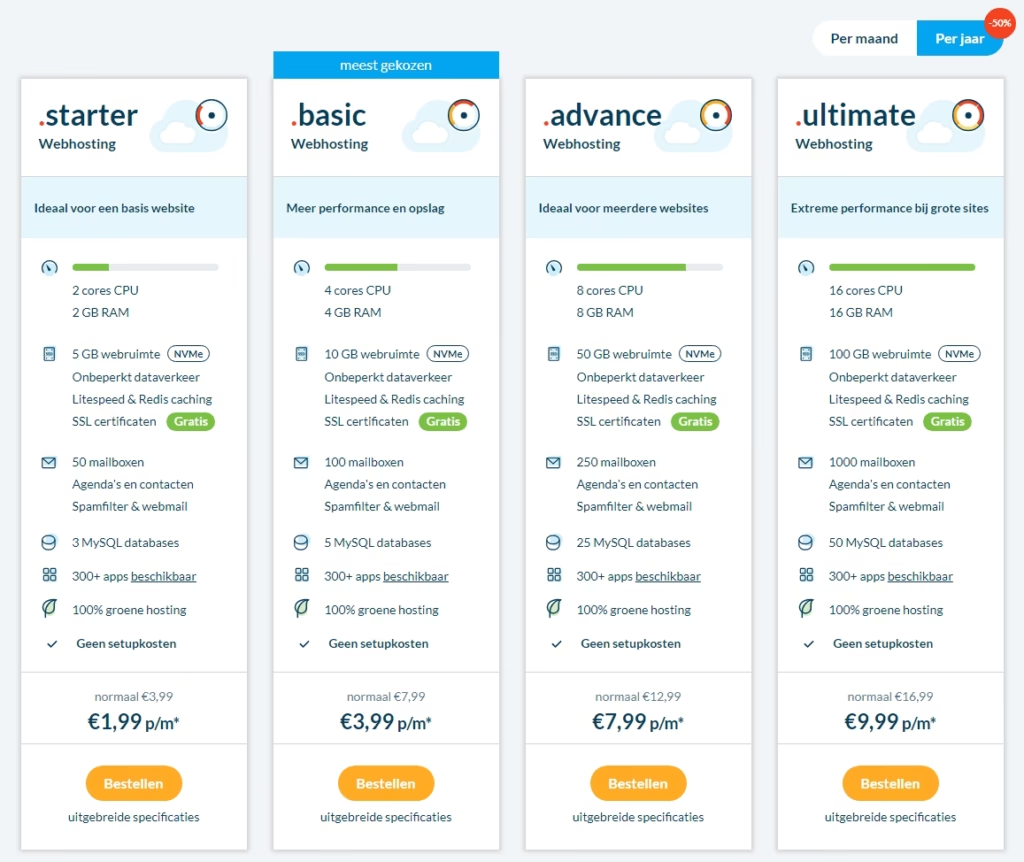
At my.host, we offer various web hosting packages at competitive prices. Additionally, you get many benefits such as free SSL certificates, a malware scanner, and hosting optimized for website speed. If you are serious about blogging, we recommend you choose one of our packages to host your website.
Ensure a good logo and design
Once your goal is clear, you have chosen a niche, a list of suitable topics, a name, and even a hosting package, you can start working on the logo, the corporate identity, and the design of your blog.
Apart from good content, it is important that your blog looks good, is easy to navigate, and is enjoyable to read. Therefore, take the time to focus on the design.
Creating a logo yourself
Are you handy with design tools like Adobe Illustrator and Photoshop? Then you can start creating your own logo. A good logo is very important so that the customer immediately knows it’s about your product. To increase your recognizability, the logo should also be consistently applied to all your communications.
For slightly less advanced designers, there are also options to create logos. Nowadays, you can make reasonably good logos with Canva. There are also various logo generators that take care of the entire work for you.
Outsourcing the design
On platforms like Fiverr and Upwork, you can have really good logos made for very little money. This is interesting if you do not have much knowledge and understanding of design yourself.
Of course, it is also possible to hire a designer; however, the costs are often significantly higher. Our experience with platforms like Fiverr and Upwork is good enough, and we recommend starting bloggers to begin here.
The logo as the basis for your website
The logo and the potential corporate identity are the foundation of your website. These colors and fonts are best used for your website so that everything fits together nicely. Depending on the CMS system you choose, the way to style the blog differs. Make sure, at the very least, you use a consistent style so that everything looks good.

The best ways to attract visitors
A blog is nothing without visitors; you obviously want people to read your content. We therefore pay extra attention to this aspect because many blogging attempts fail since the owners struggle to attract visitors.
There are various ways to attract visitors. The main channels are:
- Social media
- Newsletters
- Other websites
If you have some reach on social media, this can be an interesting channel to bring people to your blog. You can refer YouTube videos to your blog, but this can also be done through Facebook or Instagram. It is therefore a requirement that you have social media channels with reach.
Newsletters are also interesting, and we always recommend using an email service provider to send newsletters. It can also be very interesting to collaborate with other bloggers to promote your own blog.
Google remains king
Yet, in our opinion, Google remains the most important channel. Google processes more than 3.5 billion search queries per day. In every niche or topic, search activity occurs. Therefore, it is crucial to know how to be found on relevant search terms.
Becoming discoverable on Google
In Google, there are two ways to be found. This is through paid placements (Search Engine Ads or SEA) and organic placements (Search Engine Optimization or SEO). As the costs for paid placements for a blog often exceed the returns, we mainly focus on how you can be found in an organic way.
What is SEO and how to become organically discoverable on Google
The question every starting blogger wants answered: how do I get free visitors from Google? The author of this article has years of experience with SEO and has helped many websites gain thousands of visitors.
SEO consists of 3 pillars
To become organically discoverable, there are three different pillars. These are:
- Content on the website
- Technology of the website
- Authority on the website
We will delve a little deeper into each pillar so that you better understand what it entails and how you can ensure this part is well structured.

Content
The content consists of two parts. Firstly, do your articles match keywords that are actively searched for, and is the content of high enough quality so that you can actually be found with it. The best way to find out what is being searched for is by conducting a keyword research.
You look for what is being searched for, how often it is searched for, and how difficult it is to be found for it. The most well-known tools used for this are:
- Google Keyword Planner (free)
- Ahrefs (paid)
- SEMrush (paid)
- Ubersuggest (free & paid)
By compiling a list of relevant keywords with high search volumes, you have a perfect basis to align your blog topics. You can then look at each topic to see what scores well by simply checking what is currently ranking.
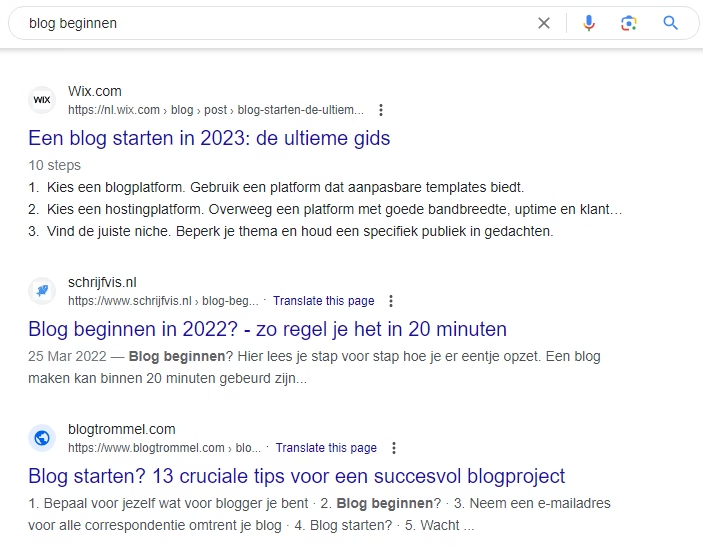
For example, for this article, I search for “starting a blog” and see what is currently scoring. This gives me an indication of the length and type of content needed to score.
Technology
Another important element for being discoverable is the technology of your website. It’s essential that Google can crawl your website properly so you can be indexed in the search engine and thus be found.
It is also important that your website is fast and generally provides a good experience for your visitors. Specifically, you should have the following matters well in hand:
- The website is well crawlable and indexed properly
- The website is fast and user-friendly for visitors
- The website meets Google’s “core web vitals”
- The website has sufficient internal links to other pages
- The website has well-optimized pages (meta titles, meta descriptions, featured images, etc.)
Technical SEO is a very extensive subject and a complete blog article could be dedicated to it. With the points above, you at least have knowledge of the most important matters.
Authority
The last factor for organic visitors is the authority of the website. This mainly depends on the number of incoming hyperlinks to your website. The more good and relevant websites link to your site, the higher your authority. Google will reward you with better positions.
Building up your authority is also known as link building. This is a specific component focused on increasing authority by getting more links to your website.
Get started with your SEO
Despite the fact that you might feel a bit overwhelmed by this information, SEO is not rocket science. By understanding and applying the above three pillars well, your blog will become successful sooner or later. Try to implement the pillars on your blog and keep learning about the subject; practice makes perfect.
At any rate, don’t make it more daunting than it is. As long as you write content that is interesting to your target audience and has value for them, you will undoubtedly be rewarded in the search engines sooner or later.
A successful blog requires perseverance
Even though you’ve read about all the different parts of a blog in this article, perhaps one thing is the most important, and that is perseverance. Starting a successful blog is simply not that easy and requires a lot of time and energy.
It can sometimes take up to 6 months before you get your first visitors. So be prepared to write a lot of content for a longer period before you really start seeing results.
The saying “perseverance pays off” is certainly applicable when creating a successful blog. As long as you follow this article closely and don’t give up, we are confident that you will succeed in setting up a successful blog. We wish you lots of success!




Leave a Reply