


Working on a domain name and hosting for your website? Then it’s good to know what SSL is. We explain it extensively in this blog.
The meaning and function of SSL
SSL stands for Secure Socket Layer and is simply a security protocol to ensure that your data cannot be easily read by third parties. An SSL encrypts the connection between your internet browser and the web server, so that only the user and the server have access to the information exchange that takes place between these two parties.
Why is SSL so important?
Especially people who value their privacy can appreciate an SSL certificate. This certificate encrypts all data exchanged between the web server and internet browser so that, for example, hackers cannot easily intercept your sensitive data.
On many sites, such as simple blogs, not much sensitive information will be exchanged, but when you are making online purchases or dealing with important matters where private information must be entered, it is very important to ensure that the site you are communicating with has an SSL certificate!
How do you know if a website has an SSL certificate?
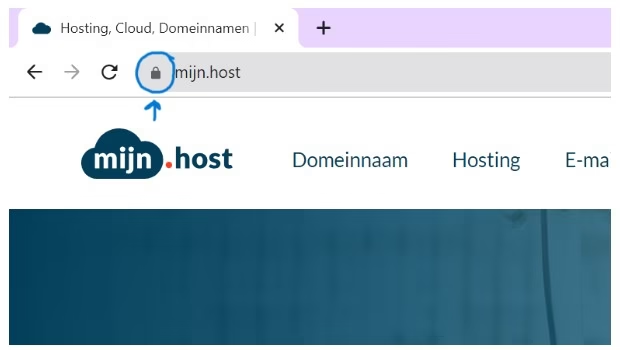
Very simple: look in the URL bar on the left side of the web address. If there is a padlock icon, then you know that your browser has a secure connection with the respective web server. If you click on the lock, you will see more details about the SSL certificate, including the issuer of this certificate. So if you want to double-check, you only need to click on the lock.
What are HTTP and HTTPS?
The padlock is not the only way you can recognize a secure connection. When you see HTTPS before the URL in your bar, it also indicates that the connection is encrypted. HTTPS stands for Hyper Text Transfer Protocol Secure.
If you only see HTTP, the connection is not ‘secure’ and is therefore not encrypted with an SSL or TLS certificate. This means that all data is sent as ‘plain text’ (or easily readable).
If you can’t find the padlock or the HTTPS, you should be very careful about entering information you don’t want to end up in the wrong hands. Think mainly of your social security number and credit card details.
What is the difference between SSL and TLS?
SSL (Secure Sockets Layer) and TLS (Transport Layer Security) are both protocols used to ensure the security of data transfer over a network, such as the internet.
TLS is a newer name in the industry and was developed to succeed SSL. In the development of TLS, attention was paid to patching the vulnerabilities of SSL. Over the years, both SSL and TLS have received several new versions under their name and they continue to be further developed.
Is SSL a better option than TLS?
In short: no. TLS generally offers a better level of security than SSL. Newer versions of TLS have stronger encryption algorithms and are more resistant to known security vulnerabilities than SSL.
Moreover, SSL is no longer being developed. The last version, SSL 3.0, was released in 1996 and still had a few known vulnerabilities. TLS was introduced in 1999 and is still actively being developed today to improve performance and security. The developers keep today’s digital threats in mind, of course.
Different types of SSL certificates
Understanding different types of SSL certificates is also of great importance in the online world. SSL certificates offer a range of options to fulfill the specific security needs of various online scenarios.
- Domain Validation (DV): The most common form of SSL, ideal for blogs and informational websites. DV certificates only verify the domain name, making them fast and affordable.
- Organization Validation (OV): For business entities that want to convey an extra level of credibility. OV certificates undergo thorough validation of the organization managing the website.
- Extended Validation (EV): The brush for online businesses aiming for the highest level of trust. EV certificates display a green address bar and undergo the strictest validation of all three validation processes.
By consciously choosing from this palette of SSL options, website owners can not only build trust with their visitors but also apply the ideal security layer that matches their type of online presence.

How do I get an SSL certificate?
Securing your website with an SSL certificate is an important step in protecting data and building trust with your visitors. Obtaining an SSL certificate is fortunately a simple process.
First, choose the right type of certificate, such as domain validation (DV), organization validation (OV), or extended validation (EV); this, of course, depends on your needs. Then obtain the certificate from a reliable certificate authority, such as for example Let’s Encrypt. Once you have the certificate, you can apply it to your server and you’re good to go!
The future of SSL and TLS
When SSL is still being talked about nowadays, we are actually talking about the TLS protocol 99% of the time. SSL may no longer be further developed, but TLS is developing at a high pace!
The most recent developments they are working on involve advanced authentication methods, for example by using biometrics and quantum-resistant cryptography where they are seeking solutions for the use of quantum computers in the hacking world.
They are also working on integrating machine learning and threat intelligence. This means that they can detect dangers early and adjust the security protocols accordingly. It seems that we can expect many exciting things from TLS!
It is now clear that SSL has played an incredibly crucial role when it comes to cybersecurity. Although it is no longer being developed, the baton has been passed to TLS, which is now one of the key players in this domain. With the amount of interactions we have online today and what kind of information we sometimes have to enter, online security has never been more important.
If you or your company want to have a website online, it is important to purchase good hosting and of course good security. At my.host you are assured of always getting the best product with the best service. Whether it’s Email hosting, WordPress hosting, or a Virtual Private Server; we are happy to help you with it!
SSL-certificaat bestellen?
Altijd een veilige https-verbinding met SSL.




Leave a Reply