


For a few years now, I’ve been earning my living through blogging.
Let’s not beat around the bush: I’ve had to walk a winding path to get to this position. More than once, I was on the verge of throwing in the towel.
You’ve landed on this page because you want to get better at blogging. Here are my most important blog tips to help you achieve this goal. Tips that I’ve mostly learned the hard way.
1. Authenticity is everything
Authenticity in creating blog content has always been important, but in recent years it’s no longer a nice-to-have but a must for long-term success.
It’s very simple: as of 2024, we’ve reached the point where an AI chatbot with a mediocre prompt can spit out content that rivals a significant percentage of human writers.
This means what many people classify as “SEO texts” are rapidly becoming completely obsolete.
The time for an encyclopedia-like piece written by a non-expert is over.
(I’m not saying there’s no success to be had with it right now. But looking at where the world is headed with search and information gathering, it’s a dead-end track.)
Bloggers who will win in the long run are those who write from their own experience, grab readers by the collar, and can share information that’s not already on 100,000 other websites or that can be produced faster, sharper, and more concisely by a chatbot.
2. “The riches are in the niches”
When my partner and I started the blog Start24, we wanted to tackle countless topics simultaneously. Entrepreneurship, accounting, web hosting, office supplies… You name it.
That was a huge mistake.
Besides the fact that it’s – especially for a starting blogger – a nightmare to package all these topics coherently within a single website, this broad approach comes with several other issues:
- It is mentally extremely challenging to delve into so many different topics. That authenticity I mentioned above? Forget about it if you want to write about many topics simultaneously.
- Search engines generally don’t favor small websites with a broad range. I can say with a fair degree of certainty that our blog would have grown significantly faster if we had been more focused.
- Keeping articles up-to-date with so many diverse topics is also enormously challenging.
What is our approach now? We have positioned our blog much more sharply and now focus on a single main topic.
If you’re starting a blog, choose a single niche and only deviate from it once you’ve become successful and fully exhausted this niche. Even then, it might be wiser to dedicate a separate website to your next niche.
3. Choose the right blog platform
There is only one suitable platform for bloggers, and that is WordPress.
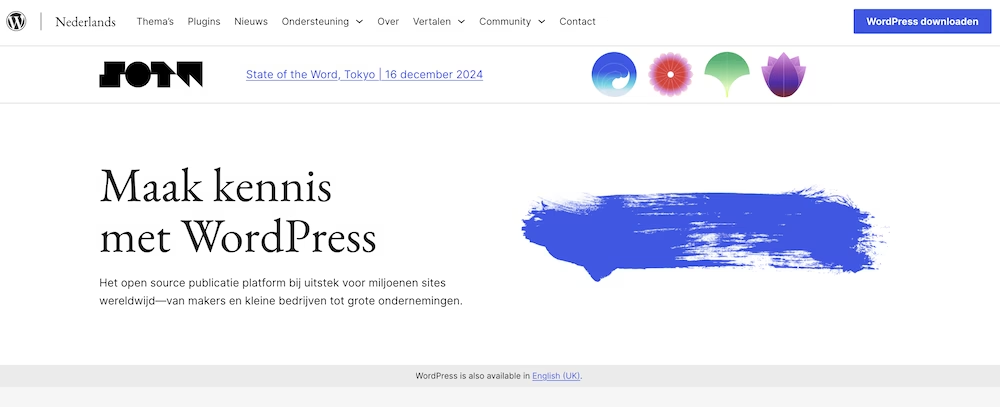
It’s not impossible to start a blog with JouwWeb, Wix, or Squarespace. But sooner or later, you’ll run into a slew of restrictions with these closed platforms that will drive you nuts.
I know dozens of successful bloggers. And I’ve yet to meet one who doesn’t use WordPress.
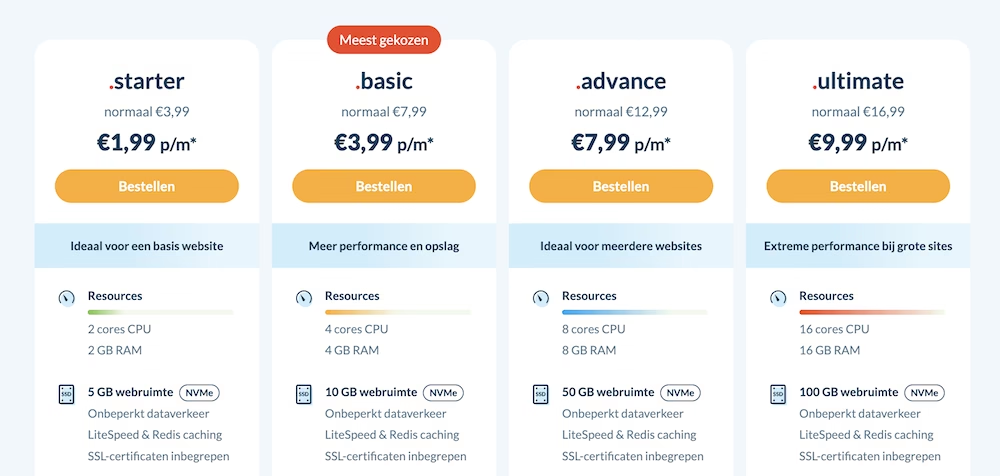
For clarity, I’m talking about WordPress.org, not WordPress.com. You can install this for free in just a few clicks on a hosting package that doesn’t need to cost more than a few euros per month.
4. Invest in good design and layout from day 1
As always, appearances matter.
Sure, content is king in a blog. But you can no longer get away with a cheerless site without appeal.
This is also something you don’t want to postpone. Often, your blog starts generating organic clicks through search engines within a few weeks. A poor design can cause your site to show less favorable engagement metrics, leading to lower rankings in search engines.
The good news is that with WordPress themes like Kadence and Blocksy, it’s not very difficult for beginners to create a beautiful blog.
Here are a few of my most important tips when it comes to good blog design and layout:
- Ensure that the font size is at least 17 pixels. The text color should also stand out sharply against the background color of your page.
- The width of your blog layout should be between 700 and 800 pixels. Blog texts spread across the full width of the page are much harder to read.
- No one likes looking at a wall of text. Break up your articles with images, tables, and other graphic elements.
- Ensure that the appearance of your design matches the topic. Readers expect a different look for a yoga blog compared to a tech blog.
5. Build an email list from day 1
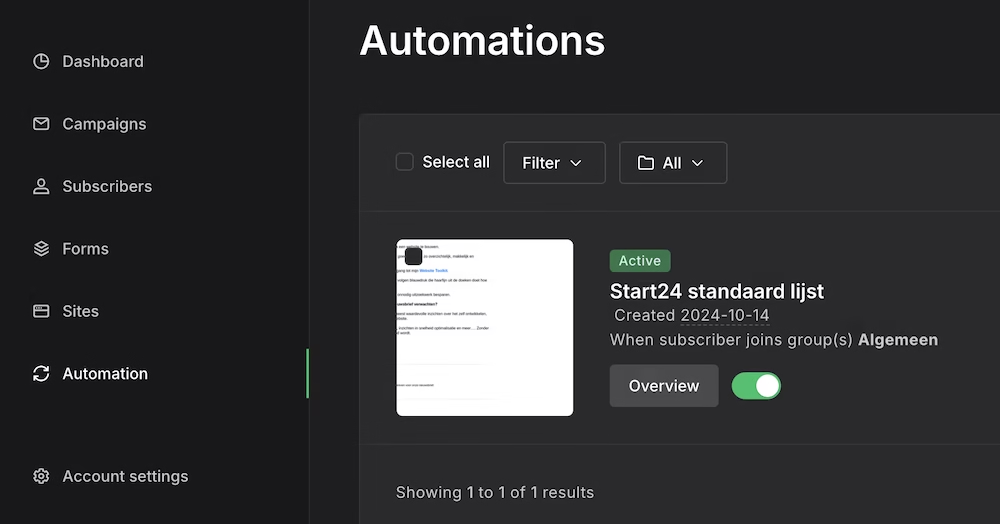
If there’s one thing I’d redo in my blogging career, it would be starting to build an email list from the very first moment.
The most interesting thing about an email list is that it truly belongs to you. A following you can reach at any moment, and that can’t just be taken away from you.
This is in contrast to Google traffic, which can fluctuate significantly.
Seriously, there’s literally no reason not to start working on your email list from day 1.
6. Use AI to streamline the blogging process
AI tools are handy for simple blogging tasks. You can use them to:
- Create meta descriptions
- Brainstorm titles
- Rephrase sentences
- Fact-check articles
…and the list goes on.
The most popular free tool is ChatGPT. I don’t use any other AI tools myself.
7. Ensure you’re not solely dependent on Google traffic
The days of creating a blog solely for Google traffic are over. This is a risky strategy because Google can wipe out your website traffic with a single algorithm update.
Identify other channels that suit your niche—such as Pinterest, LinkedIn, or Facebook—and try to drive traffic to your blog through one or more of these channels as well.
Last year, I started focusing on traffic through LinkedIn, YouTube, and my email list.
8. Keep your old content up to date
If you’re publishing so-called evergreen content, keep it up to date. I personally check my 300 most important articles every six months. I check my top 100 most important articles every quarter.
If you don’t do this, you’ll notice these articles slowly starting to sink in the search engines over time.
9. Consistency is key
The first few months of blogging will probably be easy for you. You’re brimming with enthusiasm, and articles will flow out of you like water from a rock.
But then monotony sets in. Your articles probably aren’t getting many visitors yet. You start questioning what you’re doing it all for. And that feeling of excitement when hitting the publish button has completely faded away.
Before you know it, you’ve left your blog untouched for a month, then two months.
The internet is filled to the brim with abandoned blogs. Of course, you don’t want your blog to belong to this group.
That’s why consistency is so important. Make sure to publish at least once a week. Preferably even more if you have the time.
Try not to skip weeks. Just like a healthy exercise habit you’re trying to build, momentum is of critical importance.
When you stop publishing for a week, it breaks the flow. The following week, it’s easy to come up with an excuse for yourself to skip it again.
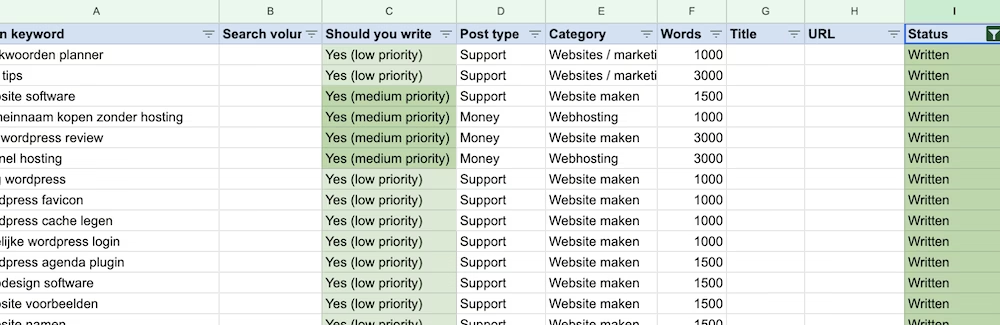
10. Create a content calendar
A content calendar creates peace of mind.
I usually create one for the next six months. This way, I don’t have to think about what I’m going to write each day.
11. Create an outline for each article
In the past, I used to start writing off the cuff once I found a topic.
This is unwise. A blank page is intimidating, and without a plan, you might miss things that the piece should contain.
Nowadays, I always set up an outline with headings and subheadings for each article, which I can then fill in bit by bit.
12. Put the answer to the question at the top
Delaying the answer in your articles is unwise. Don’t bury it 20 paragraphs deep – that’s a content tactic that’s really outdated.
Roughly speaking, you attract two types of visitors:
- People who read a piece of content from top to bottom (an increasingly rare breed)
- People who skim
It’s super important to cater well to the second group (considering how many people belong to this group). Not only by breaking up your content with subheadings, tables, and images, but also by placing the most important information at the top of the page.
This is called the “inverted pyramid” writing style, which originates from journalism and academia. The goal is to give the most important information first, followed by additional details, background information, and supporting facts in decreasing order of importance.
This meets the so-called search intent of the user. If someone wants to find a stew recipe, they probably don’t want to wade through a long story first about how your great-grandmother crafted this recipe through many experimental sessions and how it was then passed down from generation to generation.
Answer the question as quickly as possible. This will result in satisfied visitors and search engines rewarding you with better rankings.


Leave a Reply