
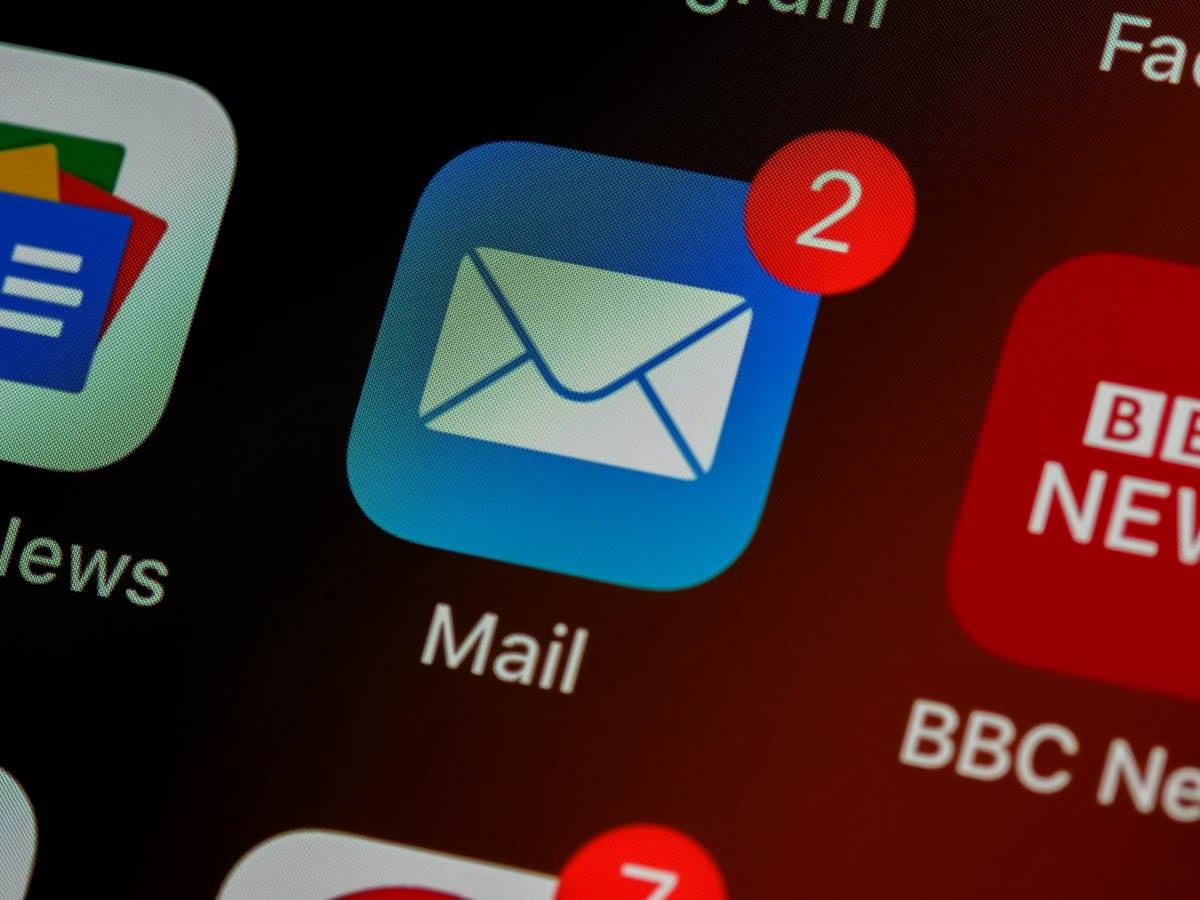

Are you busy setting up your email? Chances are you’re deciding whether to set up IMAP or POP3 for sending and receiving your emails.
But what exactly do these two ‘protocols’ mean? In this article, we will explain it clearly to you!
What is IMAP?
IMAP (Internet Message Access Protocol) is a protocol used to manage and synchronize email messages on a mail server. With IMAP, messages remain on the server, allowing you to view and manage your emails from multiple devices, such as your smartphone and laptop.
Your actions are synchronized; if you read or delete an email on one device, this is reflected on all other devices. Typically, IMAP uses port 143 or the secure port 993 for the internet connection.
- Synchronization: messages are synchronized with the server, meaning all changes you make on one device are visible everywhere.
- Folders: you can set up and manage different folders on the server, making it easier to organize your messages.

What is POP3?
POP3 (Post Office Protocol version 3) is an older protocol designed to download email messages from a server to an email client. Once a message is downloaded, it is typically removed from the server.
This means you can only view your emails from the device where they were initially downloaded. This can be useful if you do not have a constant internet connection or want to read messages offline. POP3 typically uses port 110 for the connection.
- Download: emails are downloaded to your device and can be viewed offline.
- Mailbox: after downloading, messages are essentially only accessible from the local mailbox on one device, unless the email client is set to keep copies of messages on the server.
The differences between IMAP and POP3
Well, by now you probably have a good idea of what IMAP and POP3 are. The differences are likely clear to you as well. But just to be sure, I’ll lay them out below:
IMAP and POP3 are two different protocols you use to receive email from a server over the internet. When using the Internet Message Access Protocol (IMAP), your emails remain on the server, allowing you to access your inbox from different devices.
This means that when you read a message on your phone, you will see it marked as read on your laptop. IMAP is often the preferred choice for people who want to manage and synchronize their email across multiple devices.

On the other hand, with the Post Office Protocol version 3 (POP3), you download emails to your device, and they are generally removed from the server. This is useful if you want to store your emails on a single device and if you have limited server storage.
However, if you read email on multiple devices, you will find that your actions – such as marking as read or deleting messages – are not synchronized between these devices.
The choice between IMAP and POP3 depends on your personal preferences and specific email needs.
Advanced features and use cases
Let’s take a look at the advanced features of IMAP and POP3 and how these fit into practical situations.
Synchronization and accessibility
With IMAP (Internet Messaging Access Protocol) you can keep your email messages synchronized across multiple devices such as smartphones, tablets, and laptops. Since IMAP allows your messages to remain on the server, you can access your email from any device with an internet connection.
- IMAP: messages remain on the remote server, changes are synchronized across all devices.
- POP3: downloads messages to one device, no synchronization with other devices.
Storage and security
Regarding storage space and security, POP3 (Post Office Protocol 3) stores email messages on your local device, which can provide a backup in case of server issues. Moreover, antivirus software can more easily scan local storage. However, be aware that you need sufficient local storage.
- IMAP: space on the remote server may be limited, depending on the provider (such as Gmail).
- POP3: storage depends on the capacity of your local device. Requires own backup solutions.
Client support and configuration
Most modern email clients, including Microsoft Outlook, Thunderbird, and Apple Mail, offer support for both IMAP and POP3. However, IMAP is a more modern protocol that better suits current user needs for accessing their email on multiple devices.
- IMAP: Broader support in modern email clients; requires a consistent internet connection.
- POP3: Easy to set up; uses SMTP for sending messages.
Configuring email clients with IMAP or POP3 involves the correct settings of the incoming and outgoing server, often provided by the email provider.
Do you still have questions about the use of IMAP and POP3? Or are you unsure how to set this up for your email hosting? Then contact us.
E-mail hosting bestellen?
Veilige mailbox met je eigen domeinnaam.




Leave a Reply